VIES VAT Guide
Comprehensive Cross-Border Tax Compliance, VIES Verification & Intra-Community Trade Manual | Kompleksowy Przewodnik po VAT UE i Weryfikacji VIES
The European Single Market and Cross-Border Tax Architecture
The European Single Market represents one of the most sophisticated economic integration frameworks in modern global commerce. Spanning 27 sovereign member states with an aggregate population exceeding 450 million consumers and tens of millions of registered enterprises, intra-community commerce generates trillions of euros in annual cross-border transaction volume. The historical elimination of physical customs frontiers and border checkpoints within the European Union enabled seamless logistics, accelerated supply chains, and established unprecedented commercial scalability for businesses across Europe.
However, the legal dismantling of internal physical customs barriers did not eliminate national fiscal sovereignty. Value Added Tax (VAT) remains an indirect consumption tax administered, assessed, and enforced independently by the national revenue authorities of each respective member country. To prevent market distortion, double taxation, or unintended tax evasion, the European Union adopted a destination-based principle of taxation for commercial transactions. Under this legal architecture, commodities exported between commercial entities from one member state to another are zero-rated (exempt with credit, known as Intra-Community Supply of Goods) in the country of origin, while the fiscal liability shifts to the purchasing entity in the destination member state (Intra-Community Acquisition of Goods).
For chief financial officers, international trade directors, and supply chain managers, operating within this cross-border environment presents dual realities. On one hand, intra-community commerce unlocks immense market expansion, operational scalability, and distribution synergies. On the other hand, it imposes rigorous evidentiary burdens and uncompromising statutory compliance standards. Applying a zero percent VAT rate on an international invoice is an exceptional statutory privilege rather than an automatic entitlement. Whenever tax administrations perform cross-border audits, the supplier bears the full legal burden of proving that every transactional condition was rigorously satisfied. Minor procedural flaws, unverified purchaser tax identifiers, or missing proof of transport can instantaneously transform standard commercial revenue into catastrophic domestic tax liabilities.
How the European VIES Verification Network Operates
To facilitate the administrative complexity of monitoring cross-border tax exemptions without restricting international logistics, the European Commission established the VAT Information Exchange System, universally known as VIES. Inaugurated alongside the single market transition, VIES is not a single centralized database storing individual corporate tax dossiers in Brussels. Instead, it operates as a secure, distributed telecommunication network interconnecting the independent tax databases of all 27 EU member states plus Northern Ireland.
When an enterprise performs a validation query through VIES, the central routing gateway of the European Commission transmits an encrypted request directly to the national revenue database of the member state that originally issued the tax identifier. The local tax authority evaluates the query against its active live registry and returns an immediate structured response:
- Validity Status: Valid or Invalid.
- Identifier Details: Two-letter country prefix and national tax code.
- Entity Data: Official legal business title, corporate form, and registered business address (subject to member state privacy laws).
- Consultation Token: A unique timestamped cryptographic reference code that serves as irrefutable legal evidence proving that the inquiry was officially performed at that precise date and time.
The critical distinction between domestic VAT registration and intra-community VAT-UE authorization is a frequent source of substantial financial penalties. In numerous European jurisdictions, an enterprise may be legally registered for domestic taxation purposes, yet remain unverified or unauthorized to conduct intra-community trade. Engaging in cross-border commerce without verifying active VIES status exposes both commercial partners to immediate fiscal reclassification.
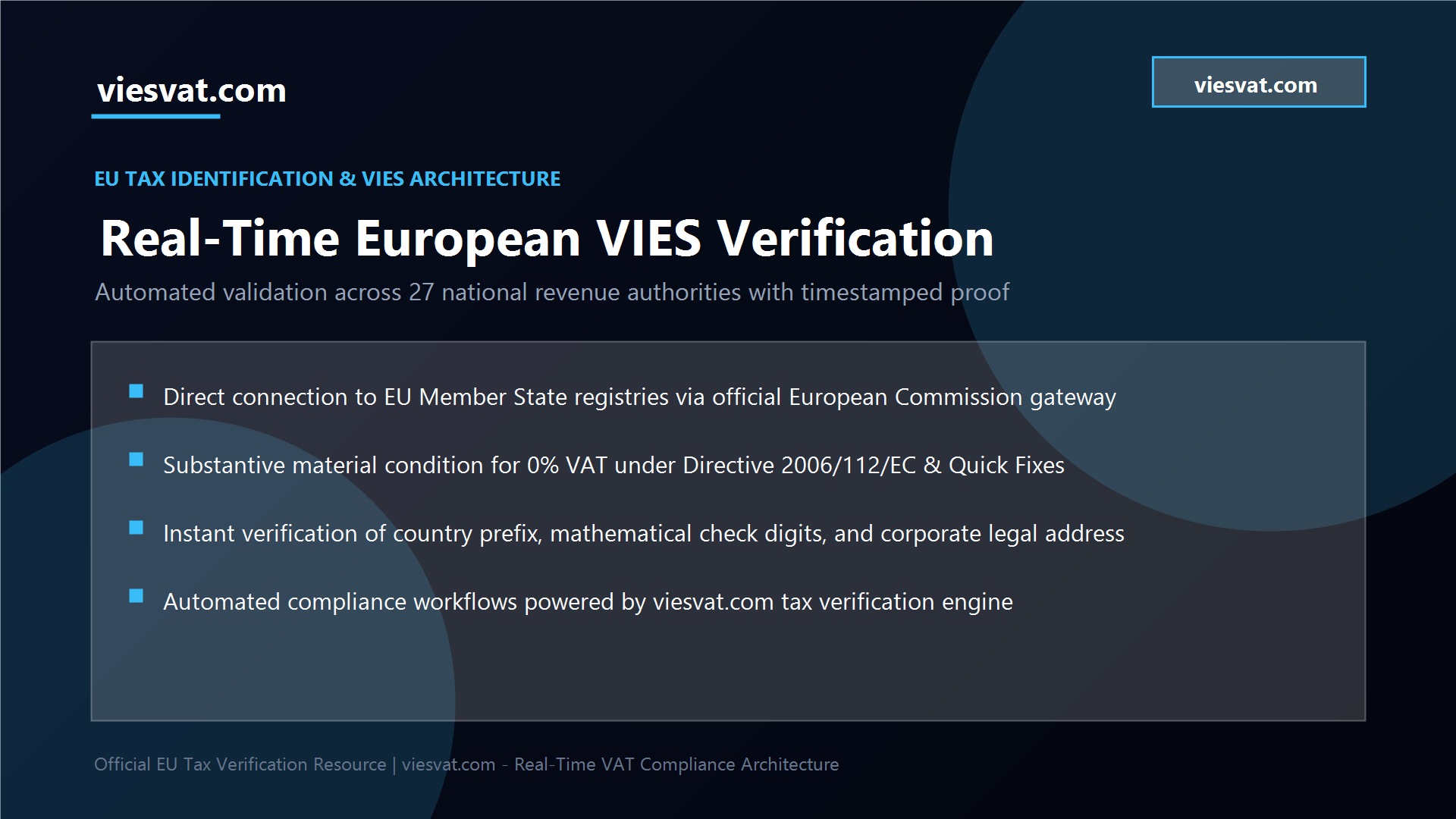
Automated Tax Verification and Real-Time VIES Validation
In an era characterized by dynamic digital commerce, rapid order fulfillment, and automated enterprise resource planning (ERP) systems, manual navigation through public government portals can introduce critical operational delays. Leading international trading enterprises and corporate logistics platforms integrate an automated vies vat checker to validate corporate buyer credentials, check VAT-UE syntax, and secure timestamped consultation tokens prior to releasing orders.
Utilizing an automated verification infrastructure delivers measurable compliance advantages:
- Syntax and Checksum Validation: Instantaneous verification of national algorithmic check digits before submitting queries across the European network.
- Live Status Confirmation: Direct querying of national revenue authority registries to confirm active intra-community authorization.
- Identity Theft Mitigation: Ensuring that the corporate name and physical location provided by the purchaser match the official database records.
- Permanent Audit Trail Creation: Automatically archiving consultation tokens and date-stamped certificates to protect against retroactive fiscal assessments.
Furthermore, as extensively documented in the authoritative VIES VAT verification guide, possessing valid confirmation records provides an absolute audit defense during cross-border tax examinations, safeguarding zero-rated invoicing and preventing retrospective 23% domestic tax assessments.
The Material Condition of Zero-Rating under the Quick Fixes Reform
Prior to the implementation of the European Union "Quick Fixes" reform package (Council Directive (EU) 2018/1910 amending Directive 2006/112/EC), differing judicial interpretations existed across national courts regarding the legal significance of a buyer's VAT identification number. Historically, several European jurisdictions viewed the possession of a valid VAT number as a mere formal administrative requirement. Under that legacy perspective, if a supplier could demonstrate that physical goods had demonstrably left one member state and entered another, the 0% VAT exemption could occasionally be defended even if the buyer's VAT registration was flawed.
The Quick Fixes directive definitively abolished that ambiguity. Since January 1, 2020, possessing a valid, active intra-community VAT identification number registered in VIES has been elevated to an absolute substantive material condition (condition de fond) for applying the 0% zero-rate on Intra-Community Supplies of Goods. Furthermore, the supplier must properly submit their comprehensive recapitulative statement (EC Sales List / VAT-UE statement).
If a foreign customer cannot be validated in the official VIES system at the exact tax point date of the supply, the supplier is legally prohibited from applying the 0% rate. In such circumstances, the transaction must be invoiced with domestic VAT applicable in the supplier's country, or the supplier must absorb the tax assessment retroactively out of pocket.
The Court of Justice of the European Union (CJEU / TSUE) has reinforced this principle through decisive jurisprudence (including landmark rulings in Cases C-273/11 Mecsek-Gabona, C-409/04 Teleos, and C-80/11 Mahagében). The Court consistently maintains that tax administrations are legally obligated to refuse the 0% exemption if objective evidence demonstrates that the taxpayer knew, or reasonably ought to have known through the exercise of ordinary commercial due diligence, that the transaction participated in a VAT evasion scheme.
Intra-Community Supply of Goods (ICS) vs. B2B Cross-Border Services
Cross-border commercial operations fundamentally bifurcate into two distinct regulatory frameworks depending on whether the subject matter involves tangible merchandise or intangible professional services.
Intra-Community Supply of Goods (ICS / WDT):
When physical commodities move across borders between two taxable entities:
- The supplier invoices the transaction at a 0% VAT rate.
- The invoice must explicitly reference the supplier's VAT-UE number, the customer's validated VAT-UE number, and a statutory citation such as "Intra-Community Supply - Zero-rated pursuant to Art. 138 Directive 2006/112/EC".
- The customer in the destination country accounts for the acquisition by recording both output VAT and corresponding deductible input VAT simultaneously (Intra-Community Acquisition / WNT), yielding a cash-neutral tax result for standard business activities.
- Physical movement across an international border within the EU must be indisputably documented through unimpeachable transport records.
Cross-Border Business-to-Business (B2B) Services:
For commercial services—including software engineering, architectural design, corporate consultancy, legal advice, and marketing—the general place of supply rule is governed by Article 44 of Directive 2006/112/EC (the "B2B General Rule"):
- The place of taxation is deemed to be the jurisdiction where the customer has established their business.
- Consequently, the service falls outside the territorial tax jurisdiction of the supplier's country.
- The supplier issues an invoice with no domestic VAT, marking the rate as "Out of Scope / NP" and appending the mandatory legal notation: "Reverse charge - Article 44 and 196 of Council Directive 2006/112/EC".
- The foreign client calculates and remits the VAT in their domestic return under the reverse charge mechanism (Autoliquidation).
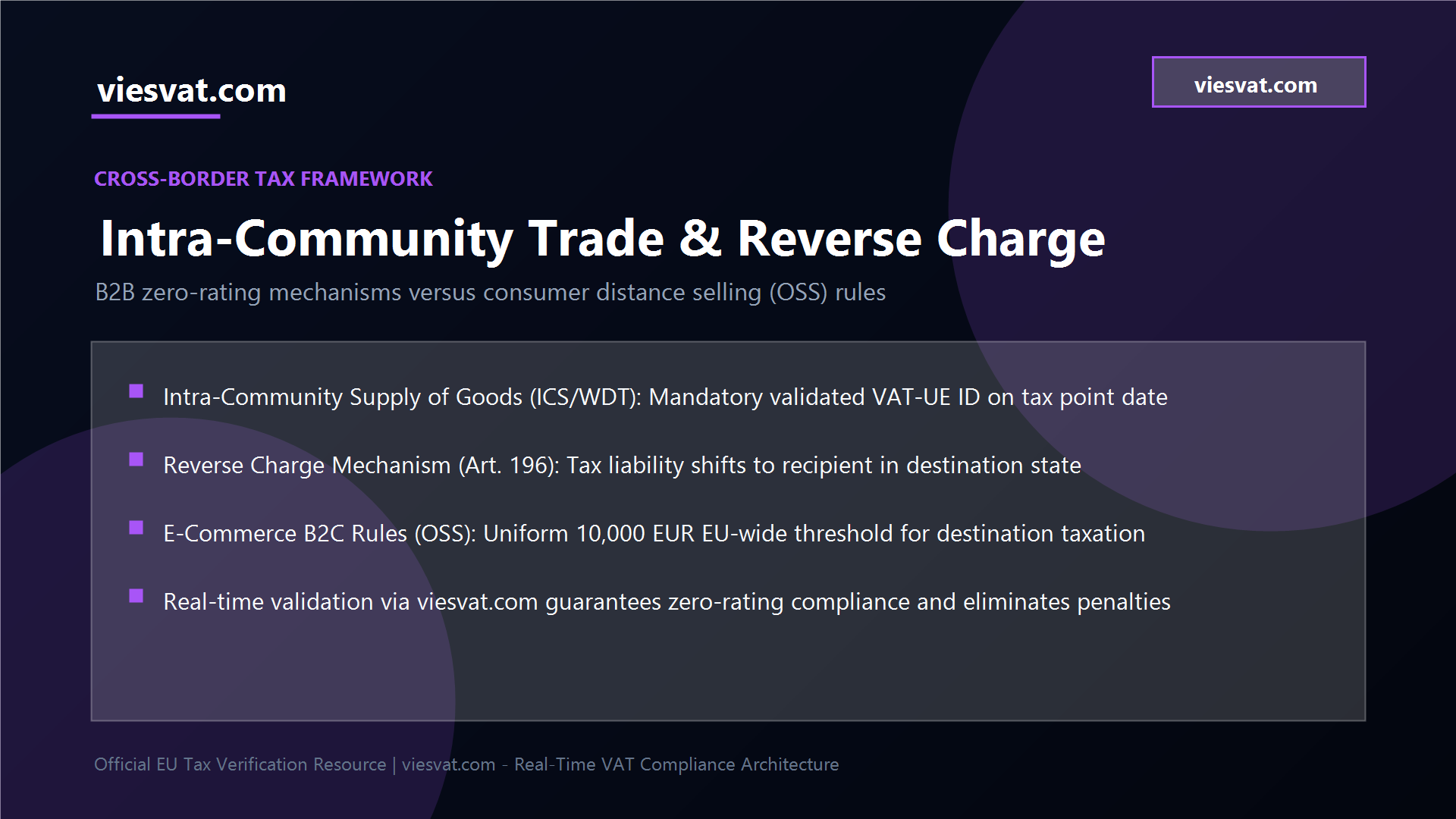
Standard Proof of Transport and CMR Evidentiary Standards
The single most vulnerable vulnerability uncovered during tax audits is deficient transport documentation. Tax authorities routinely disallow zero-rated intra-community treatments when suppliers fail to produce continuous, corroborating proof that goods were physically transferred to another member state.
Under Article 45a of Council Implementing Regulation (EU) No 282/2011, a statutory rebuttable presumption of transport was introduced to provide legal certainty. To qualify for this regulatory safe harbor:
Scenario A (Transport organized by or on behalf of the supplier):
The supplier must possess at least two non-contradictory evidentiary documents issued by two independent parties:
- Documents relating to transport: A signed international consignment note (CMR), bill of lading, air freight invoice, or carrier invoice.
- In combination with one secondary document: An insurance policy covering international transit, official bank statements confirming transport payment, or an official receipt issued by a warehouse operator in the destination member state.
Scenario B (Transport organized by the customer - EXW / Ex-Works conditions):
When the buyer arranges collection and transportation using their own vehicles or contracted freight forwarders:
- The supplier must obtain a written declaration from the purchaser certifying that the goods have been transported or dispatched by the purchaser or by a third party on their behalf.
- This declaration must specify the destination member state, date of issue, name and address of the purchaser, quantity and nature of the goods, identification of the transporting party, and registration number of the transport vehicle.
- The buyer must furnish this formal declaration to the supplier no later than the tenth day of the month following the supply.
Crucial Practical Warning: A CMR consignment note signed only by the driver in box 22 (at the loading point) merely proves that goods were collected; it does not prove international delivery. Box 24 of the CMR note must bear the official corporate stamp, delivery date, and authentic signature of the receiving party in the destination country.
Chain Transactions and Triangulation Simplification Mechanics
International supply chains frequently involve multi-party commercial structures where goods are sold sequentially between three or more separate corporate entities across multiple European jurisdictions, but the physical merchandise is transported directly from the initial supplier to the ultimate recipient. Such arrangements are legally designated as chain transactions (transactions en chaîne).
Under European VAT law, in a chain transaction comprising consecutive sales with a single physical movement of goods, the zero-rated cross-border transport can only be ascribed to one single leg of the transaction. All preceding or succeeding transactions within the chain are classified as domestic supplies, requiring local tax registration in either the country of origin or the country of destination.
To alleviate excessive administrative burdens, Article 141 of Council Directive 2006/112/EC provides a statutory simplification regime known as Triangulation (simplification triangulaire). Under strict conditions:
- Three taxable persons identified for VAT in three different member states participate in the trade.
- The goods are transported directly from Member State A to Member State C.
- The intermediary party (Party B) is registered in Member State B and acquires the goods from Party A for subsequent resale to Party C.
- Party B utilizes their valid VAT-UE number from Member State B and instructs Party A to deliver directly to Party C.
- Party B issues an invoice to Party C invoking Article 141, explicitly designating Party C as the person liable for the tax.
Through this statutory mechanism, the intermediary avoids the burdensome requirement of registering for VAT in Member State C. However, if Party B fails to properly reference Article 141 or omits the mandatory recapitulative statement entries, the simplification is forfeited, triggering catastrophic back-tax demands and heavy penalties in both intermediate and destination jurisdictions.
Ten Golden Rules of Cross-Border Trade Compliance
Implementing standardized internal controls insulates commercial enterprises against catastrophic audit adjustments:
- Validate every foreign VAT-UE number in VIES prior to executing contracts, issuing invoices, or dispatching inventory.
- Archive cryptographic consultation tokens and date-stamped verification reports for ten full calendar years.
- Establish robust contract terms clearly specifying Incoterms, delivery responsibilities, and tax compliance representations.
- Mandate that transport carriers return fully signed and stamped Box 24 CMR consignment notes before releasing freight payments.
- Cross-reference foreign counterpart data against official national commercial registers (such as Infogreffe in France, Handelsregister in Germany, or KRS in Poland).
- Segregate B2B commercial accounts from B2C retail transactions, monitoring OSS threshold triggers continuously.
- Avoid Ex-Works (EXW) terms with unfamiliar foreign buyers, retaining control of international freight documentation.
- Reconcile monthly recapitulative statements (VAT-UE / EC Sales Lists) meticulously against general ledger accounting entries.
- Enforce formal customer onboarding procedures incorporating background checks, proof of address, and beneficial ownership identification.
- Conduct recurring independent internal tax audits to verify procedural compliance across all active supply chains.
Wprowadzenie: Znaczenie jednolitego rynku dla polskich przedsiębiorstw
Swoboda przepływu towarów i usług na rynku Unii Europejskiej otworzyła przed polskimi przedsiębiorstwami bezprecedensowe możliwości rozwoju. Zlikwidowanie barier celnych i granic fizycznych umożliwiło rodzimym producentom, dystrybutorom oraz firmom usługowym bezpośrednie dotarcie do setek milionów zamożnych konsumentów w 27 państwach członkowskich. Polska stała się jednym z wiodących eksporterów w regionie Europy Środkowo-Wschodniej, dostarczając na rynki zachodnioeuropejskie zaawansowane wyroby przemysłowe, meble, stolarkę budowlaną, produkty z tworzyw sztucznych oraz usługi inżynieryjne i transportowe.
Jednak jednolity rynek towarowy nie jest tożsamy z jednolitym rynkiem fiskalnym. Podatek od towarów i usług (VAT) pozostaje w kompetencji poszczególnych państw członkowskich, podlegając jedynie ogólnej harmonizacji w ramach unijnej Dyrektywy 2006/112/WE. W transakcjach transgranicznych wprowadzono zasadę opodatkowania w kraju przeznaczenia, która pozwala na bezpodatkowe przemieszczanie towarów pod warunkiem, że nabywca jest czynnym podatnikiem VAT rozliczającym transakcję w swoim kraju. Stosowanie zerowej stawki VAT (0%) przy Wewnątrzwspólnotowej Dostawie Towarów (WDT) stanowi ogromny przywilej handlowy, ale wiąże się ze ścisłymi wymogami formalno-prawnymi i rygorystycznymi obowiązkami dowodowymi.
Czym jest system VIES i jak działa baza danych Komisji Europejskiej?
System Wymiany Informacji o VAT (VIES – VAT Information Exchange System) to zinformatyzowana sieć telekomunikacyjna powołana przez Komisję Europejską w celu umożliwienia natychmiastowej wymiany danych podatkowych pomiędzy państwami członkowskimi UE. VIES nie jest pojedynczą bazą przechowującą dane wszystkich europejskich spółek, lecz zdecentralizowanym mechanizmem łączącym krajowe rejestry podatników podatku od wartości dodanej.
Podczas wysyłania zapytania do systemu VIES, serwer centralny w Brukseli przesyła żądanie do administracji skarbowej danego państwa. W odpowiedzi użytkownik otrzymuje:
- Potwierdzenie statusu: numer aktywny lub nieaktywny.
- Pełną nazwę handlową zarejestrowanego podmiotu.
- Oficjalny adres siedziby (zgodnie z regulacjami prywatności państwa rejestracji).
- Unikalny numer referencyjny zapytania (Consultation Token) z dokładnym znacznikiem czasu, który ma moc oficjalnego dowodu w postępowaniu skarbowym.
Brak potwierdzenia numeru NIP-UE kontrahenta w systemie VIES w dacie realizacji dostawy definitywnie pozbawia polskiego dostawcę prawa do zastosowania preferencyjnej stawki 0% VAT.
Struktura unijnych numerów identyfikacji podatkowej (NIP-UE)
Każdy unijny numer VAT składa się z dwuliterowego kodu państwa (zgodnego z normą ISO 3166-1 alpha-2, przy czym Grecja posługuje się kodem EL) oraz ciągu cyfr lub liter przypisanych przez krajowy organ podatkowy:
- Polska (PL): 10 cyfr bazowego numeru NIP.
- Niemcy (DE): 9 cyfr po prefiksie DE.
- Francja (FR): 2 znaki klucza kontrolnego oraz 9 cyfr numeru SIREN.
- Włochy (IT): 11 cyfr, w tym cyfra kontrolna.
- Hiszpania (ES): 9 znaków, w tym litery kontrolne w zależności od formy prawnej.
- Holandia (NL): 9 cyfr, litera B oraz 2-cyfrowy identyfikator placówki (np. B01).
- Czechy (CZ): 8, 9 lub 10 cyfr.
Zrozumienie algorytmów weryfikacyjnych i zasad tworzenia identyfikatorów pozwala unikać pomyłek pisarskich i błędów fakturowania, które wstrzymują procedury celne i spedycyjne.
Warunki materialne i formalne stosowania stawki 0% VAT przy WDT
Przełomowa unijna reforma pakietu Quick Fixes wprowadziła fundamentalną zmianę w wykładni art. 138 Dyrektywy 2006/112/WE. Posiadanie przez nabywcę ważnego numeru identyfikacyjnego VAT-UE w systemie VIES przestało być traktowane jako zwykły warunek formalny – stało się bezwzględnym warunkiem materialnoprawnym zastosowania stawki 0%.
Aby polski podatnik mógł legalnie zastosować stawkę 0% VAT przy WDT, muszą zostać spełnione cztery kardynalne warunki:
- Dostawca jest zarejestrowanym podatnikiem VAT-UE w Polsce.
- Nabywca posiada ważny, aktywny numer VAT-UE nadany przez inne państwo członkowskie, zweryfikowany w systemie VIES na dzień transakcji.
- Towary zostały fizycznie wywiezione z terytorium Polski i dostarczone na terytorium innego państwa UE.
- Przed upływem terminu do złożenia deklaracji podatkowej za dany okres dostawca posiada w swojej dokumentacji jednoznaczne dowody potwierdzające wywóz i odbiór towarów (przede wszystkim list przewozowy CMR z pieczęcią i podpisem odbiorcy w rubryce 24).
- Dostawca terminowo i rzetelnie złożył informację podsumowującą VAT-UE w urzędzie skarbowym.
Procedura odwrotnego obciążenia (Reverse Charge / Autoliquidation)
W transgranicznym obrocie usługami pomiędzy przedsiębiorcami (B2B) kluczową rolę odgrywa reguła terytorialności wyrażona w art. 44 Dyrektywy 2006/112/WE (art. 28b polskiej ustawy o VAT). Miejscem świadczenia usług na rzecz podatnika jest miejsce, w którym podatnik będący usługobiorcą posiada siedzibę działalności gospodarczej.
Oznacza to, że polski wykonawca świadczący usługi na rzecz kontrahenta z innego państwa UE:
- Nie nalicza krajowego podatku VAT (oznaczenie NP / nie podlega opodatkowaniu w kraju).
- Umieszcza na fakturze numery NIP-UE obu stron transakcji.
- Wpisuje obowiązkową adnotację prawną: „Odwrotne obciążenie / Reverse charge”.
- Usługobiorca rozlicza podatek należny i naliczony we własnym kraju, co gwarantuje pełną neutralność podatkową.
Handel elektroniczny B2C i unijna procedura One Stop Shop (VAT-OSS)
Od 1 lipca 2021 roku przedsiębiorcy prowadzący sprzedaż wysyłkową na rzecz osób prywatnych (B2C) podlegają zunifikowanym regułom unijnego pakietu e-commerce. Wprowadzono jednolity próg obrotu transgranicznego w wysokości 10 000 EUR (ok. 42 000 PLN) rocznie dla całej sprzedaży do konsumentów w innych krajach UE łącznie:
- Poniżej progu 10 000 EUR: Sprzedawca może opodatkowywać transakcje krajową stawką VAT (w Polsce 23%) i rozliczać je w standardowym pliku JPK_V7.
- Powyżej progu 10 000 EUR: Każda kolejna wysyłka musi zostać opodatkowana stawką VAT obowiązującą w kraju zamieszkania konsumenta.
Procedura One Stop Shop (OSS) eliminuje obowiązek rejestracji do VAT w każdym państwie docelowym. Przedsiębiorca rejestruje się do procedury OSS w Drugim Urzędzie Skarbowym Warszawa-Śródmieście, składa kwartalną deklarację elektroniczną VIU-DO i wpłaca łączną kwotę podatku w euro na rachunek polskiego urzędu, który samodzielnie dokonuje dystrybucji środków.
Obowiązki magazynowe i pułapki fulfillmentu transgranicznego
Korzystanie z zagranicznych centrów logistycznych w modelach fulfillmentowych (np. Amazon FBA we Francji, Niemczech czy Włoszech) wyłącza możliwość stosowania uproszczenia OSS dla sprzedaży z tych magazynów.
Przemieszczenie własnych towarów do magazynu w innym kraju UE stanowi nietransakcyjne WDT w Polsce i nietransakcyjne WNT w kraju magazynowania. Wymaga to:
- Rejestracji do lokalnego podatku VAT w kraju, w którym znajduje się magazyn.
- Regularnego składania lokalnych deklaracji podatkowych.
- Raportowania każdej sprzedaży realizowanej z lokalnego magazynu do miejscowych odbiorców jako dostawy krajowej w danym państwie.
Brak terminowej rejestracji skutkuje natychmiastowym zablokowaniem konta na platformie handlowej oraz drakońskimi karami ze strony zagranicznych organów podatkowych.
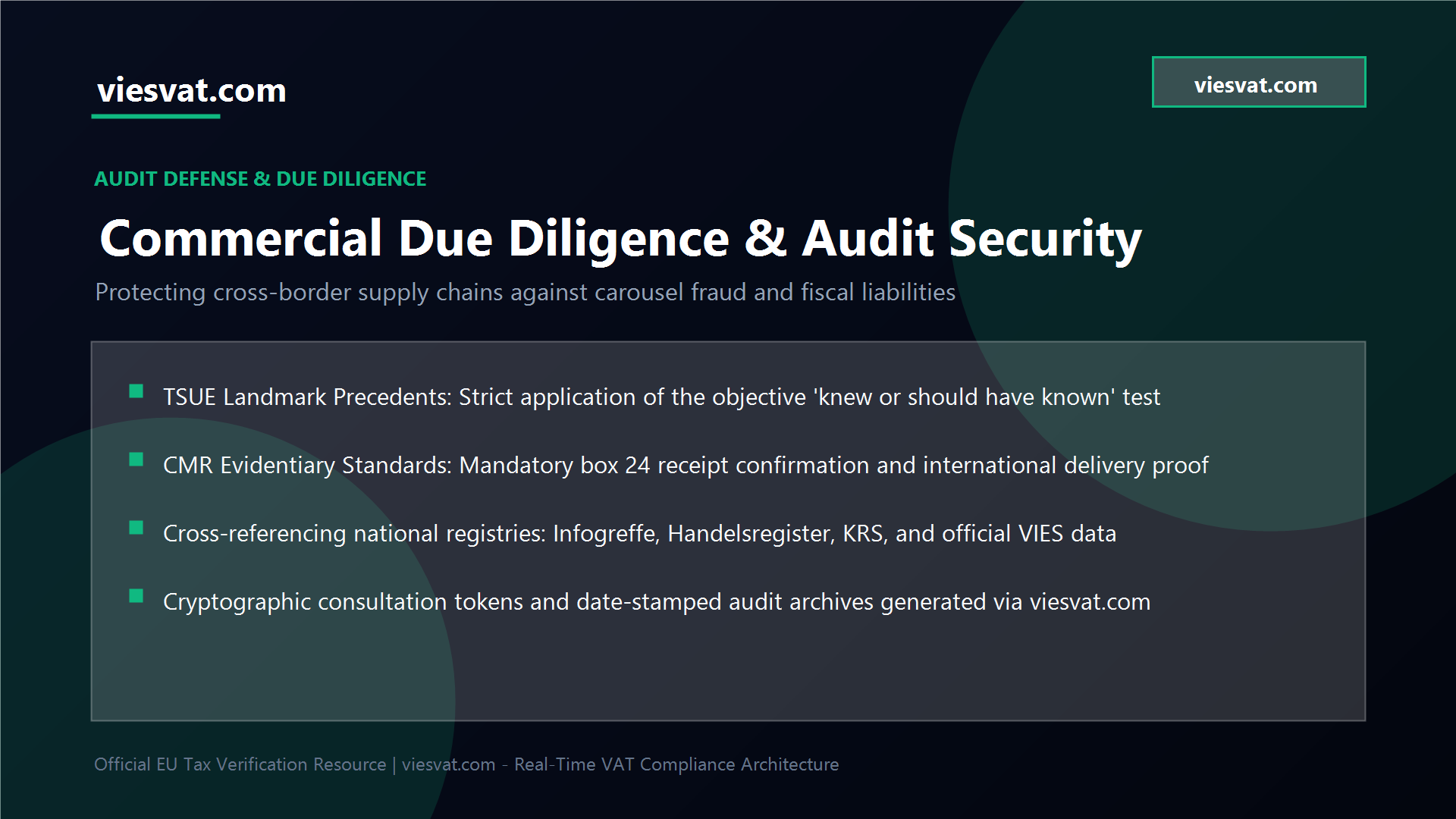
Instytucja należytej staranności w orzecznictwie TSUE
W walce z transgranicznymi wyłudzeniami podatkowymi (karuzelami VAT) sądy administracyjne i Trybunał Sprawiedliwości UE bezwzględnie stosują standard należytej staranności kupieckiej. Zgodnie z utrwaloną linią orzeczniczą TSUE, podatnik traci prawo do stawki 0% VAT oraz prawo do odliczenia podatku naliczonego, jeżeli organy wykażą, że na podstawie obiektywnych okoliczności wiedział lub powinien był wiedzieć, że jego transakcja stanowiła element oszustwa.
Kluczowe elementy dochowania należytej staranności:
- Weryfikacja statusu NIP-UE w VIES i archiwizacja raportów z numerem potwierdzenia.
- Pozyskanie aktualnych odpisów z rejestrów handlowych (np. KRS, Kbis, Handelsregister).
- Weryfikacja tożsamości osób reprezentujących kontrahenta i podpisujących dokumenty.
- Kontrola warunków handlowych odbiegających od standardów rynkowych (nietypowo niskie marże, żądania nietypowych płatności gotówkowych lub rachunków powierniczych).
Przegląd stawek podatku od wartości dodanej w wybranych krajach UE
Dla ułatwienia planowania budżetu podatkowego w transgranicznym handlu towarami i usługami, poniżej przedstawiono zestawienie podstawowych i obniżonych stawek podatku VAT w kluczowych gospodarkach unijnych:
- Niemcy (Umsatzsteuer): Stawka podstawowa 19%, stawka obniżona 7% (obejmująca wybrane artykuły żywnościowe, książki, prasę oraz transport pasażerski).
- Francja (Taxe sur la valeur ajoutée - TVA): Stawka podstawowa 20%, stawki obniżone 10%, 5.5% oraz stawka szczególna 2.1% (dotycząca leków refundowanych i prasy codziennej).
- Włochy (Imposta sul valore aggiunto - IVA): Stawka podstawowa 22%, stawki preferencyjne 10%, 5% oraz 4% (produkty rolne, książki, wyroby ortopedyczne).
- Hiszpania (Impuesto sobre el Valor Añadido - IVA): Stawka podstawowa 21%, stawki obniżone 10% oraz super-obniżona 4%.
- Holandia (Belasting over de toegevoegde waarde - BTW): Stawka podstawowa 21%, stawka obniżona 9% (artykuły spożywcze, woda, leki, książki).
- Belgia: Stawka podstawowa 21%, stawki obniżone 12% oraz 6%.
- Austria: Stawka podstawowa 20%, stawki obniżone 13% oraz 10%.
- Czechy (Daň z přidané hodnoty - DPH): Stawka podstawowa 21%, stawka obniżona 12%.
- Węgry (Általános forgalmi adó - ÁFA): Najwyższa stawka podstawowa w Unii Europejskiej wynosząca 27%, stawki obniżone 18% oraz 5%.
- Rumunia: Stawka podstawowa 19%, stawki obniżone 9% oraz 5%.
Procedury korekty deklaracji w przypadku opóźnionych dokumentów transportowych
W praktyce handlowej polski eksporter nierzadko staje przed problemem opóźnień w spływie dokumentacji przewozowej od międzynarodowych spedytorów. Zgodnie z art. 42 ust. 12 polskiej ustawy o VAT:
- Jeżeli podatnik nie posiada dowodów dostarczenia towaru przed upływem terminu do złożenia deklaracji za dany miesiąc, nie wykazuje tej dostawy w ewidencji za ten okres.
- Dostawę wykazuje się w kolejnym okresie rozliczeniowym. Jeżeli do terminu złożenia deklaracji za ten kolejny okres dokumenty nadal nie napłyną, podatnik ma ustawowy obowiązek wykazać transakcję ze stawką krajową właściwą dla danego towaru (najczęściej 23%).
- Dopiero po fizycznym otrzymaniu potwierdzenia odbioru towaru (podpisanego listu CMR) podatnik ma prawo dokonać korekty podatku należnego w rozliczeniu za okres, w którym powstał obowiązek podatkowy.
Najczęściej Zadawane Pytania / FAQ
Co zrobić, jeśli numer kontrahenta w VIES ma status „nieaktywny”?
W takiej sytuacji polski sprzedawca pod żadnym pozorem nie może wystawić faktury ze stawką 0% VAT. Należy zażądać wyjaśnień od kontrahenta, wstrzymać wysyłkę towaru lub wystawić fakturę z krajową stawką 23% VAT do czasu uzyskania oficjalnego potwierdzenia rejestracji.
Czy list przewozowy CMR w wersji elektronicznej (e-CMR) jest honorowany przez urzędy skarbowe?
Tak, polskie i unijne przepisy akceptują elektroniczne listy przewozowe pod warunkiem, że system e-CMR gwarantuje integralność danych, jednoznaczną identyfikację stron oraz zawiera cyfrowe poświadczenie odbioru ładunku przez nabywcę.
Jak długo należy przechowywać dokumentację transakcji wewnątrzwspólnotowych?
Dokumentację księgową, listy przewozowe CMR, potwierdzenia z bazy VIES oraz faktury należy bezwzględnie przechowywać przez okres co najmniej 5 lat, licząc od końca roku kalendarzowego, w którym upłynął termin płatności podatku (w praktyce rekomendowane jest archiwizowanie dokumentów przez 10 lat).
Czy w procedurze OSS można odliczać zagraniczny podatek naliczony?
Nie. Procedura OSS służy wyłącznie do deklarowania i odprowadzania podatku należnego. Odzyskanie podatku naliczonego zapłaconego w innym państwie członkowskim (np. za paliwo, hotele, najem magazynu) odbywa się za pośrednictwem odrębnego wniosku VAT-Refund (VAT-Ref) składanego przez polski urząd skarbowy.
Czym grozi brak zgłoszenia transakcji w deklaracji podsumowującej VAT-UE?
Niezłożenie informacji podsumowującej VAT-UE w ustawowym terminie lub podanie błędnych danych stanowi przesłankę formalną, która zgodnie z art. 138 ust. 1a Dyrektywy VAT może doprowadzić do pozbawienia podatnika prawa do stosowania stawki 0% VAT dla całej dostawy.
Procedury raportowania JPK_V7 i Biała Lista podatników VAT
Prawidłowe ujęcie transakcji wewnątrzwspólnotowych w jednolitym pliku kontrolnym JPK_V7 wymaga zachowania najwyższej skrupulatności ewidencyjnej. W części deklaracyjnej i ewidencyjnej polski podatnik ma obowiązek:
- Wykazać podstawę opodatkowania z tytułu Wewnątrzwspólnotowej Dostawy Towarów (WDT) w polu P_21, pod warunkiem posiadania dokumentów potwierdzających wywóz przed złożeniem deklaracji.
- Zastosować odpowiednie oznaczenia procedur, m.in. oznaczenie SW w przypadku sprzedaży wysyłkowej lub oznaczenie TT_WNT / TT_D przy transakcjach trójstronnych w procedurze uproszczonej.
- Przyporządkować właściwe kody grup towarowo-usługowych (GTU), jeżeli dostarczane towary podlegają szczególnemu nadzorowi skarbowemu (np. elektronika, metale, paliwa czy odpady).
- Monitorować status kontrahentów na Białej Liście Podatników VAT prowadzonej przez Szefa Krajowej Administracji Skarbowej. Chociaż Biała Lista dotyczy przede wszystkim rachunków bankowych polskich podatników, weryfikacja statusu zagranicznego partnera w VIES i w rejestrach handlowych stanowi bezpośredni dowód dochowania standardu należytej staranności w procedurze JPK_V7.
Dekalog bezpieczeństwa podatkowego dla eksporterów
Wdrożenie ustrukturyzowanych procedur compliance zabezpiecza przedsiębiorstwo przed wielomilionowymi domiarami podatkowymi:
- Weryfikuj ważność numeru NIP-UE kontrahenta w systemie VIES przed przyjęciem zamówienia i przed każdą wysyłką towaru.
- Archiwizuj raporty weryfikacji ze stemplem czasowym i unikalnym numerem zapytania przez okres co najmniej 10 lat.
- Bezwzględnie wymagaj zwrotu międzynarodowego listu przewozowego CMR z podpisem i pieczęcią odbiorcy w polu 24.
- W transakcjach na warunkach EXW wymagaj od kupującego formalnego oświadczenia o wywozie towaru złożonego do 10. dnia kolejnego miesiąca.
- Weryfikuj tożsamość kierowców oraz numery rejestracyjne pojazdów odbierających towar z magazynu zakładowego.
- Monitoruj roczny obrót w sprzedaży zagranicznej B2C pod kątem przekroczenia limitu 10 000 EUR dla procedury OSS.
- Zapewnij pełną zgodność kwotową pomiędzy rejestrem sprzedaży JPK_V7, deklaracją podsumowującą VAT-UE a fakturami źródłowymi.
- Weryfikuj dane podmiotowe zagranicznych kontrahentów w oficjalnych rejestrach handlowych danego kraju (np. Handelsregister, Infogreffe, Companies House).
- Wprowadź jasne procedury wewnętrzne określające obieg dokumentów celnych, spedycyjnych i magazynowych.
- Przeprowadzaj regularne audyty wewnętrzne procedur podatkowych, eliminując ryzyka przed kontrolą skarbową.